

Seven reasons to invest in Congo
Read more...
Entering and working in the Congo
Read more...
Other opportunities
Read more...
The Congo : Presentation
Read more...
EVENTS

Congo: An Economy in Transformation, New Growth Prospects and Investment Opportunities to Seize
Congo,BrazzavilleGrowth, economic diversification, private sector development, financing of the economy and changes in the banking landscape: several recent signals point to a gradual transformation of the economic environment of the Republic of the Congo.
As the country continues its efforts to broaden its growth engines and strengthen its attractiveness, new prospects are emerging for investors, businesses and development partners.
Four recent developments help to better understand this dynamic.
1. Growth projected at 6.9% in 2027
According to the Congolese Economic Outlook, published in September 2026 by the General Directorate of the Economy, Congo’s economic growth could reach 6.9% in 2027, compared with a forecast of 5.5% in 2026.
This increase would be supported both by the expected performance of the oil sector and by the continued development of non-oil activities.
Beyond the expected growth rate, this trend highlights a strategic issue for the Congolese economy: consolidating new growth engines and accelerating diversification in order to sustainably strengthen value creation in the country.
For investors, the growth of non-oil activities is therefore an important indicator to monitor when identifying sectors and value chains with development potential.
2. Diversifying the Economy’s Sources of Financing
Financing is also a central issue in the transformation of the Congolese economy.
During the second session of the permanent consultation framework between the Republic of the Congo and Treasury Securities Specialists (SVT), held in Douala in September 2026, discussions focused in particular on the prudential constraints of banking institutions, their exposure limits to Congolese government securities, and the conditions needed to improve the liquidity of securities.
Broadening the investor base and developing secondary market trading were also among the orientations examined.
These discussions illustrate the need to continue diversifying the economy’s financing mechanisms and to foster a financial environment better able to support private investment and structuring projects.
3. Four High-Potential Sectors to Accelerate Diversification
One of the most significant signals of this dynamic came from the Country Private Sector Diagnostic (CPSD) for the Republic of the Congo, presented in Brazzaville on September 17, 2026 by the International Finance Corporation (IFC), a member of the World Bank Group.
The diagnostic identifies four priority sectors likely to contribute strongly to economic diversification:
- processed wood;
- port logistics, particularly along the Pointe-Noire–Brazzaville corridor;
- maize milling and agro-industry;
- aquaculture.
According to the IFC, removing the main constraints currently holding back these sectors could mobilize up to USD 1.4 billion in private investment and help create 22,200 jobs by 2030.
These sectors offer concrete possibilities for local processing, value chain development and job creation.
Processed wood could in particular benefit from greater local value addition from forest resources. Port logistics relies on the assets of the deep-water port of Pointe-Noire and the corridor to Brazzaville. In agro-industry, maize milling opens up prospects for local processing, while aquaculture meets growing demand and offers possibilities for developing new production chains.
The diagnostic nevertheless stresses that realizing these opportunities will depend on the ability to remove several constraints, particularly regarding access to financing, electricity, land, regulation and logistics procedures.
4. A Broadening Banking Landscape
The financial sector is also changing with the authorization granted to CCA-Bank to establish operations in the Republic of the Congo.
After obtaining the favorable opinion of the Central African Banking Commission (COBAC) in July 2026, the Congolese Minister of Finance authorized, on August 31, 2026, the opening of a branch of the Cameroonian bank in Congo.
This establishment is part of CCA-Bank’s regional expansion strategy within CEMAC and constitutes a further development in the Congolese banking landscape.
The arrival of a new banking player comes in a context where access to financing and capital mobilization are precisely important issues for private sector development and economic diversification.
Converging Signals for Investors
Taken together, these different developments outline a significant evolution in the Congolese economic environment.
Projected higher growth, high-potential non-oil sectors, new prospects for financing the economy and a broadening banking landscape are all elements to be incorporated into the analysis of prospects for the Congolese market.
Diversification thus appears as a major axis of the economy’s transformation, with opportunities emerging in particular in wood processing, logistics, agro-industry and aquaculture, as well as in the services and related activities needed to develop these value chains.
For domestic and international investors, the challenge now is to better identify these sectors, assess their development conditions and understand the reforms and mechanisms likely to facilitate project implementation.
Congo, a Market to Know Better
In this changing environment, the availability of reliable and regularly updated economic information is an essential factor in informing investment decisions.
Through its investment promotion mission, the Investment Promotion Agency (API Congo) helps highlight the opportunities offered by the Republic of the Congo and facilitate investors’ access to useful information on the business environment, high-potential sectors and investment opportunities.
In a transforming economy, identifying opportunities, understanding the environment and anticipating changes are essential steps for building sustainable investment projects in Congo.
INVEST IN DIASPORA
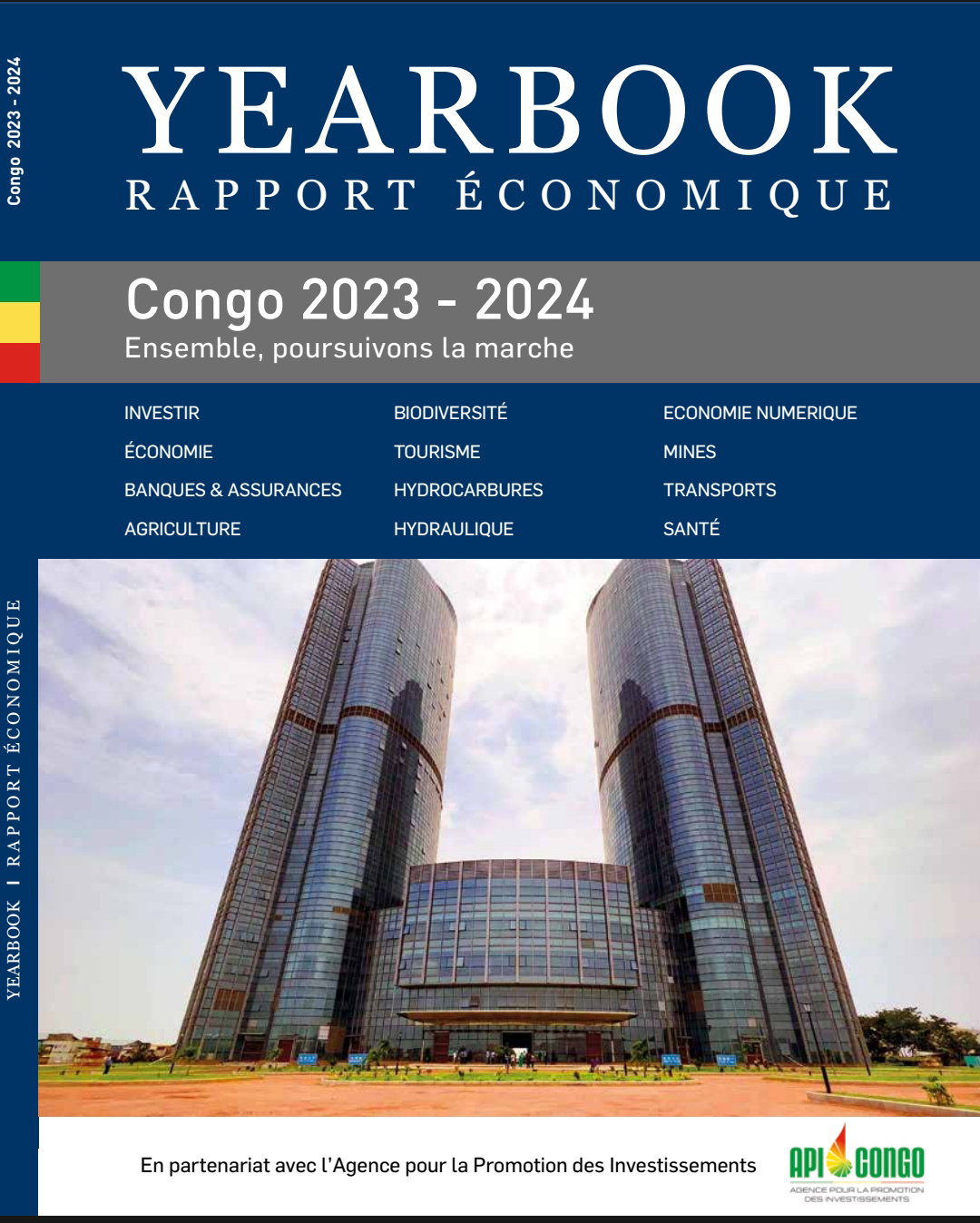
The yearbook, Economic Report 2023-2024 is now available.
Download (French version)
Consult (English version)
If you are interested in obtaining a copy, please contact API's general management.
News
- Congo: An Economy in Transformation, New Growth Prospects and Investment Opportunities to Seize
- The Republic of the Congo: New Prospects for Mobilizing Capital and Accelerating Investment
- API Congo Strengthens Partnership with the Embassy of Congo in France to Promote the Congo Destination
- Congo Brazzaville Continues Reforms to Strengthen Its Attractiveness
- Congo Brazzaville Confirms its Attractiveness to Investors
- WORKING VISIT OF THE MINISTER OF INDUSTRIAL DEVELOPMENT, SPECIAL ECONOMIC ZONES, AND PRIVATE SECTOR PROMOTION TO THE INVESTMENT PROMOTION AGENCY (API)
- The Investment Promotion Agency (API) has a new supervisory Minister
- COLLABORATION DYNAMICS BETWEEN API CONGO AND API MALI
- Participation of the Investment Promotion Agency (API-Congo) in the 4th Edition of the UK-Francophone West and Central Africa Forum on Trade and Investment in Lomé, from November 12 to 13, 2025.
- RECEPTION BY THE CEO OF API OF THE PRESIDENT OF THE ORGANIZING COMMITTEE OF THE ECONOMIC FORUM FOR GROWTH AND INVESTMENT IN CENTRAL AFRICA (FECIAC)
- PRESENTATION BY MS. ANNICK PATRICIA MONGO, CEO OF API TO FEMALE SENATORS AND SENATE EMPLOYEES ON THE THEME: "ENTREPRENEURSHIP: A Tool for Empowerment of Congolese Women"
- STRENGTHENING COOPERATION BETWEEN THE INVESTMENT PROMOTION AGENCY (API-CONGO) AND THE EMBASSY OF SOUTH AFRICA IN CONGO
September 30, 2026
Congo,Brazzaville
09/09/2026
Congo
Wednesday, August 5, 2026
France
3 July 2026
Brazzaville, Congo
13 July 2026
Brazzaville, Congo
May 20, 2026
Brazzaville
May 10, 2026
Congo
March 27, 2026
Brazzaville, Congo
Npvember 12, 2025
Lomé, Togo
March 27, 2025
Brazzaville
March 8, 2025
Brazzaville
Wednesday, March 12, 2025
Brazzaville
Our network of partners


+
Millions of inhabitants in population
+
Commercial events every year
+
More than 190 million inhabitants accessible across 4 borders
Seven reasons to invest in Congo
I. Congo Brazzaville, a corridor at the heart of Central Africa .
The Congo serves as an access route for Central African countries countries of Central Africa, such as the Central African Republic Chad, Cameroon and Gabon Read more......
II. An abundance of natural resources
6 billion barrels of crude oil reserves ; 130 billion in potash reserves; Other reserves: iron, tin, uranium, phosphate, limestone, zinc, lead, copper, etc. Read more......
III. Access to a market of over 174 million consumers
Investing in Congo Brazzaville means benefiting from : Congo's domestic market ; the CEMAC and CEAC markets Read more......
IV. A non-discriminatory legal and regulatory framework
Entrepreneurial freedom is guaranteed by the Constitution and the Investment Charter; Any natural or legal person Read more......
V. Tax incentives
National and foreign companies can benefit from the advantages of the Investment Charter under three (3) schemes Read more......
VI. Special economic zones
There are four (4) incentive measures: export incentives, reinvestment of profits reinvestment of profits, establishment in landlocked areas, etc. Read more......
VII. Continuous improvement in the business climate
The Congo has four (4) special economic zones: Read more......
Contact
Address
152, Avenue Charles de Gaulle,Plateau ville,
quartier ex-trésor, en face du GAB
de la banque UBA.
contact@apicongo.cg
Call us
+ 242 06 666 81 62